





































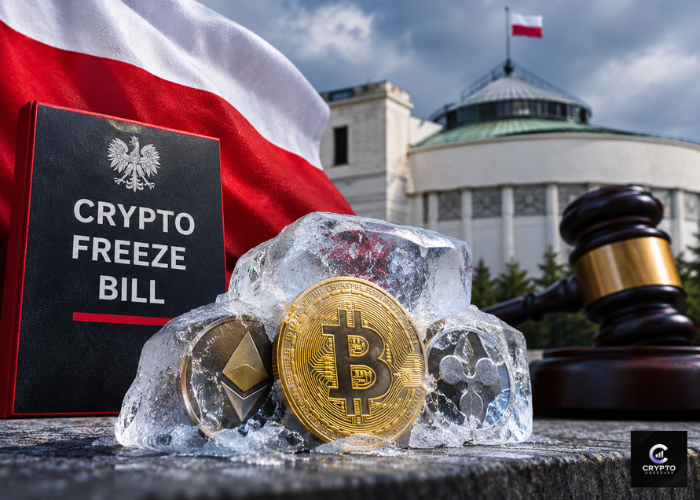
Poland’s lower house has approved legislation that would expand government powers to freeze cryptocurrency assets belonging to sanctioned individuals and organisations, even before a court reaches a final decision. The proposal now moves to the Senate, raising questions about digital asset ownership, sanctions enforcement and legal safeguards.
Poland has taken a significant step towards expanding its national sanctions framework to cover cryptocurrency holdings. On November 6, 2026, the country’s lower house of parliament, the Sejm, approved the government-backed Act on Restrictive Measures by 240 votes to 202, with one abstention.
The proposed legislation explicitly recognises crypto assets as financial resources that can be frozen under national sanctions. It would give the Interior Minister authority to impose restrictions on designated individuals and organisations, with decisions becoming enforceable before affected parties complete a judicial challenge.
The development is attracting attention across the digital asset industry because it addresses an important question: how far can governments extend traditional financial sanctions into cryptocurrency markets?
However, the proposal does not authorise a blanket freeze on Bitcoin or other cryptocurrencies held by ordinary investors. Its provisions focus on individuals and organisations placed on Poland’s national sanctions list.
What Does Poland’s Crypto Freeze Bill Actually Propose?
The Act on Restrictive Measures would explicitly include crypto assets within the financial resources covered by Poland’s sanctions framework.
The legislation uses the definition of crypto assets established under the European Union’s Markets in Crypto-Assets Regulation (MiCA). This brings digital assets into the same sanctions framework as bank deposits, account balances, securities and other financial resources.
Under the proposed rules, freezing financial resources means restricting their movement, transfer, use, availability or transactions that could change their ownership, location or value.
This could affect cryptocurrency holdings managed through regulated exchanges, custodians and other financial service providers.
Importantly, the proposal targets designated individuals and organisations rather than cryptocurrency ownership as a whole. Ordinary Bitcoin holders are not automatically subject to restrictions simply because they own or trade digital assets.
How Would Authorities Be Able to Freeze Cryptocurrency?
The proposal places responsibility for maintaining Poland’s national sanctions list with the Interior Minister.
Authorities could initiate restrictions against individuals or organisations that meet the legislation’s specified sanctions-related criteria. These include providing support to countries subject to restrictive measures, involvement in serious human rights violations and certain activities involving foreign interference or information manipulation that threaten national security.
Once a designation is published in the government’s Public Information Bulletin, the relevant restrictions would become enforceable the following day.
The affected individual or organisation could challenge the administrative decision before a court. However, the proposed framework does not automatically suspend the restrictions while that legal challenge is underway.
This is one of the most consequential parts of the proposal. A designated party could lose access to covered financial resources before a court delivers its final judgment.
Why the Bill Matters for Cryptocurrency Exchanges and Wallets
The proposed legislation could have practical consequences for cryptocurrency exchanges, custodians and other service providers operating in Poland.
These developments also highlight the growing importance of institutional crypto infrastructure, particularly in areas such as digital asset custody, regulatory compliance and the secure management of financial resources.
If a customer is added to the national sanctions list, institutions holding or managing that customer’s assets could be required to prevent prohibited transfers and access. This would make sanctions screening and compliance procedures particularly important for businesses handling digital assets.
Self-custodied wallets present a different enforcement challenge. A person controlling a private wallet holds the private keys directly rather than relying on an exchange or custodian. The legislation’s inclusion of crypto assets does not automatically give the Polish government control of those keys or the technical ability to transfer funds from a decentralised wallet.
However, self-custody does not necessarily place a sanctioned person’s assets outside the reach of sanctions. Restrictions could still affect transactions involving regulated exchanges and other service providers.
The distinction between freezing access through an intermediary and directly controlling blockchain assets is important when assessing how the proposed law could be enforced.
Property Rights and Legal Safeguards Remain Important Questions
The proposal also raises questions about the balance between national security measures and individual property rights.
Under the proposed framework, affected individuals and organisations can challenge their designation through administrative court proceedings. However, Article 9 states that the decision remains effective until the court judgment becomes final.
This means the legal challenge would not automatically restore access to frozen assets while proceedings continue.
The legislation also provides a mechanism for authorising access to certain frozen funds for essential expenses. These include basic needs such as food, housing, medical treatment and other qualifying expenses, subject to the conditions and approval procedures set out in the legislation.
For cryptocurrency businesses, the issue extends beyond asset restrictions. They may also need to consider how quickly sanctions decisions are communicated, how customer identities are verified and how restrictions are implemented across their services.
Poland’s Crypto Freeze Bill Is Separate From Its MiCA Licensing Dispute
Another important distinction is that this proposal is not the same as Poland’s separate cryptocurrency market legislation.
Poland has been involved in a political dispute over its domestic implementation of the EU’s Markets in Crypto-Assets Regulation. The separate crypto-assets market bill sought to establish a national supervisory framework, including a central role for the Polish Financial Supervision Authority.
President Karol Nawrocki vetoed that legislation in June 2026. The Sejm subsequently failed to secure the required majority to override the veto in September.
The Act on Restrictive Measures addresses a different issue: enforcing sanctions against designated individuals and organisations, including through restrictions on digital assets.
Although both developments affect Poland’s cryptocurrency sector, they should not be presented as a single regulatory initiative.
What Happens Next?
The Sejm forwarded the Act on Restrictive Measures to the Senate on November 9, 2026. The upper house has 30 days to consider the legislation and can approve it, introduce amendments or reject it.
If the Senate does not take action within that period, the bill is treated as approved in the version passed by the Sejm under Poland’s constitutional procedure. The legislation would then proceed to the president for consideration.
As of November 11, the proposal has not completed the legislative process and should not be described as an active law.
The next important development will be the Senate’s decision and the subsequent presidential review.
For the wider cryptocurrency industry, the proposal highlights how traditional sanctions frameworks are expanding to explicitly cover digital assets. Its eventual implementation could increase compliance responsibilities for crypto service providers while keeping questions about administrative authority, judicial oversight and self-custody at the centre of the regulatory debate.