





































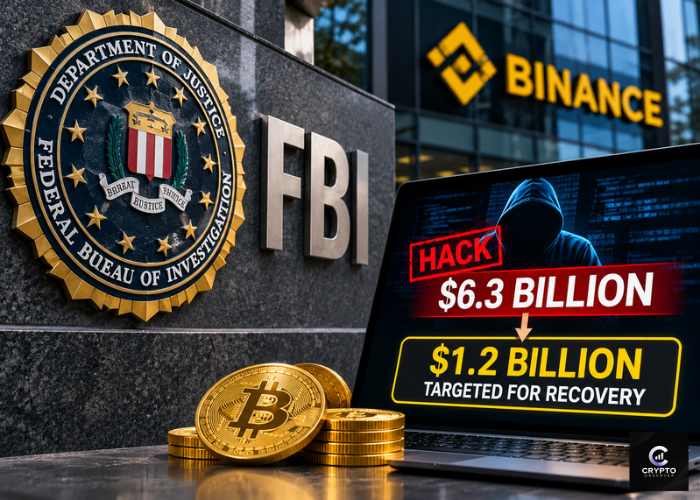
DOJ Moves to Seize $1.2 Billion in Stolen Binance Crypto
The Justice Department announced the court-authorized seizure and restraint action on November 12, marking a major development in the investigation into the Binance breach.
According to the department, coordinated efforts between US government agencies and private-sector cryptocurrency companies have resulted in more than $2.7 billion worth of stolen digital assets being frozen. More than $1.2 billion of that amount is covered by the court authorization.
The distinction matters. The $2.7 billion represents the broader pool of frozen assets, while the $1.2 billion is the portion targeted through the government’s legal action. These figures do not represent separate recoveries.
The investigation involves the Justice Department’s National Security Division, its Criminal Division, the FBI and other law enforcement partners. The US Secret Service and Internal Revenue Service Criminal Investigation division are also assisting with efforts to trace the stolen funds.
Authorities say the attackers continue moving cryptocurrency through blockchain bridges, mixers and exchanges in an attempt to launder the proceeds. Investigators are working with virtual asset service providers to identify suspicious transactions and prevent additional funds from leaving their reach.
How the $6.3 Billion Binance Hack Unfolded
The attack occurred on or around October 29, 2026, when North Korean military-linked cyber actors stole more than $6 billion in virtual assets from Binance.
The exchange’s reported financial impact reached approximately $6.3 billion, making it one of the largest cryptocurrency thefts ever recorded.
The FBI subsequently attributed the operation to TraderTraitor, a hacking group associated with North Korea. On October 31, the agency issued a cyber alert identifying cryptocurrency addresses connected to the stolen funds and warning virtual asset service providers about the attackers’ laundering activity.
The FBI’s initial attribution and investigation into the incident are covered in our earlier report on the North Korea-linked TraderTraitor group and the Binance hack.
The FBI urged exchanges and other cryptocurrency businesses to block transactions involving the identified addresses and funds derived from them.
Investigators have been tracing the stolen cryptocurrency as it moves between blockchain networks and digital asset services. Converting assets and moving them through multiple platforms can complicate recovery, particularly when transactions cross jurisdictions and involve services with different compliance requirements.
The precise technical entry point behind the Binance breach has not been fully established in the Justice Department’s public announcement. As a result, the attack’s specific technical mechanics should not be treated as confirmed.
FBI Attributes the Attack to North Korea’s TraderTraitor
The FBI has linked the Binance theft to TraderTraitor, a North Korean military-associated hacking operation.
The attribution places the incident within a wider pattern of cryptocurrency-related cybercrime that US authorities associate with North Korean operations. American officials have repeatedly accused North Korean cyber actors of stealing digital assets to generate revenue for the country’s government and support prohibited activities, including weapons programs.
The latest Justice Department announcement also highlighted the role of cryptocurrency industry cooperation in disrupting the operation.
Assistant Attorney General A. Tysen Duva credited the Criminal Division and its partners with freezing billions of dollars in stolen assets before they moved beyond the reach of investigators. The department said its coordination with virtual asset service providers was critical to the recovery effort.
North Korea has rejected accusations of involvement in cryptocurrency theft operations in previous public statements. The FBI’s attribution represents the US government’s assessment of the attack.
Binance Replenishes All $6.34 Billion in Affected Customer Assets
While US authorities pursue the stolen funds, Binance has separately addressed the financial impact on its customers.
On November 12, the exchange confirmed that it had completed replenishing the assets affected by the October 29 breach, committing more than $6.34 billion in company resources.
The replenishment involved funds from Binance’s corporate treasury, its Secure Asset Fund for Users (SAFU) and surplus capital from its Futures Insurance Fund.
Binance also published an updated Proof of Reserves snapshot covering 198 tokens. The snapshot was taken at 00:00 UTC on November 12, with the exchange estimating that generating the complete zero-knowledge proof would require another 40 to 50 hours. Once available, the proof is intended to allow customers to verify that their eligible balances are backed at a minimum 1:1 ratio.
The exchange also committed to rebuilding its SAFU emergency reserve to approximately $1 billion.
The customer replenishment and government recovery efforts are separate developments. Binance has replaced the affected customer assets using its own resources, while investigators continue pursuing the cryptocurrency controlled by the attackers.
DOJ Targets a Separate North Korean Crypto Theft Operation
The November 12 announcement also included a separate enforcement action against a North Korean social engineering campaign known as FaceStealer.
According to the Justice Department, the operation stole more than $400 million in cryptocurrency over an 18-month period by targeting cryptocurrency holders and individuals working in the open-source software ecosystem.
The campaign reportedly used deceptive video calls, compromised messaging accounts and deepfake technology to impersonate trusted contacts. Victims were manipulated into installing malicious software after being presented with fabricated technical problems during seemingly legitimate online meetings.
US authorities seized cloud-based infrastructure associated with the campaign and said the FBI had recovered more than 900 webcam videos connected to victims.
Although FaceStealer is unrelated to the Binance breach, the separate investigation highlights the range of cyber operations that US authorities attribute to North Korean actors targeting the digital asset industry.
What the Binance Recovery Means for Crypto Security
The Binance incident highlights the security challenges facing cryptocurrency exchanges and the wider digital asset industry.
The ability to freeze billions of dollars in stolen cryptocurrency demonstrates the importance of cooperation between exchanges, blockchain analytics providers, law enforcement agencies and other virtual asset service providers.
However, the ongoing movement of stolen funds through bridges, mixers and exchanges shows that identifying and recovering cryptocurrency remains difficult, particularly when attackers operate across multiple blockchain networks and jurisdictions.
The incident also puts greater attention on exchange custody arrangements, transaction authorization systems and the procedures used to protect large pools of customer assets.
For the cryptocurrency industry, the investigation is an important test of how effectively public authorities and private companies can respond to large-scale digital asset theft.
What Happens Next?
The Justice Department has confirmed that efforts to trace, freeze, seize and forfeit the stolen Binance cryptocurrency remain ongoing.
The court-authorized action covering more than $1.2 billion is an important step, but it does not mean that the entire amount has already been permanently forfeited or returned to its rightful owners. Those outcomes remain subject to legal proceedings.
Investigators are continuing to monitor wallets associated with TraderTraitor and work with cryptocurrency service providers to prevent further movement of the stolen assets.
Binance has completed its customer asset replenishment, but the broader investigation into the $6.3 billion theft is far from over.