































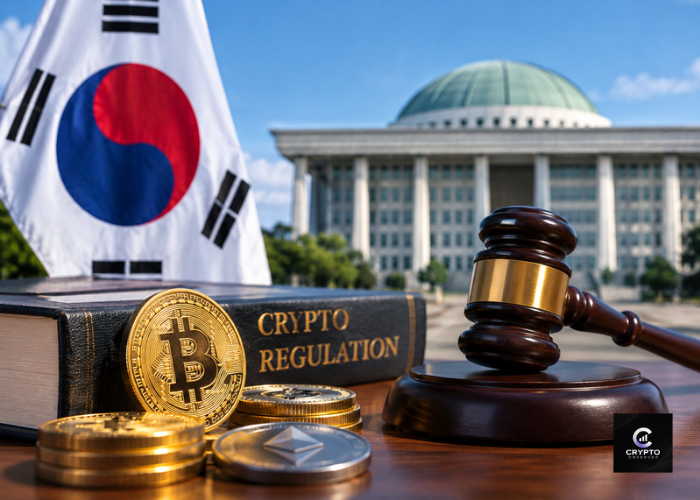
South Korea is preparing a major overhaul of its cryptocurrency industry, with proposed legislation that could reopen domestic Initial Coin Offerings (ICOs) after a nine-year ban and introduce new rules for stablecoin issuers and cryptocurrency exchanges.
On November 24, 2026, the country’s Financial Services Commission (FSC) presented a draft legislative proposal titled the Act on the Innovation of the Digital Asset Industry and Protection of Users. The proposed framework aims to establish clearer operating requirements for digital asset businesses while strengthening investor protection and encouraging industry innovation.
The proposal introduces three particularly significant changes: bank-backed stablecoin issuance, regulated domestic ICO fundraising and restrictions on cryptocurrency exchange ownership. However, the legislation still requires parliamentary approval before becoming law.
South Korea Proposes Bank-Backed Stablecoin Issuance
One of the most significant elements of the proposal is a regulatory framework for stablecoins pegged to the South Korean won.
Under the proposed rules, banks must collectively hold more than 50% ownership in stablecoin-issuing consortiums during the initial phase. Fintech and technology companies can also participate, potentially becoming the largest individual shareholders while maintaining the collective bank ownership requirement.
Stablecoin issuers would face several financial and operational requirements:
- Minimum capital: At least 5 billion South Korean won in equity capital.
- Reserve backing: Reserves equivalent to 100% of outstanding stablecoins.
- Regulatory approval: Issuers must obtain an FSC licence.
- Redemption: Holders must be able to redeem tokens at face value.
- Interest restrictions: Issuers cannot pay interest to stablecoin holders.
The framework also provides a potential pathway for overseas stablecoin issuers to operate in South Korea, subject to local regulatory requirements.
These measures could create opportunities for financial institutions, payment providers and blockchain companies seeking to participate in regulated stablecoin infrastructure.
Traditional banks are already exploring this direction, with Emirates NBD’s Liv integrating the USDU stablecoin into its digital banking ecosystem, demonstrating how stablecoins are entering traditional banking.
South Korea Could Lift Its Nine-Year ICO Ban
South Korea is also considering reopening domestic Initial Coin Offerings after prohibiting the fundraising method in 2017.
The proposed legislation would allow companies to raise capital through token offerings under a disclosure-based regulatory framework. Issuers would be required to submit white papers to the FSC before launching their offerings.
These disclosures would provide information about the issuing company, token structure, fundraising objectives and associated investment risks.
If approved, the framework could give blockchain startups and digital asset businesses a regulated domestic fundraising mechanism instead of relying on overseas markets.
However, the proposed changes do not immediately legalise ICOs. Existing restrictions remain until the legislative process is completed.
Crypto Exchanges Face Proposed 20% Ownership Cap
Another major change concerns the ownership structure of cryptocurrency exchanges.
The FSC’s proposal generally limits major shareholders to a 20% ownership stake in digital asset trading platforms. Exceptions of up to 34% could be permitted with regulatory approval.
Existing exchanges would reportedly receive a three-year transition period to comply with the proposed restrictions.
The provision could affect established South Korean platforms, including Upbit and Bithumb, depending on their existing ownership arrangements.
The proposed framework also introduces separate regulatory classifications for digital asset trading, brokerage, custody and investment management businesses. This would allow regulators to apply licensing and supervisory requirements according to the activities performed by each company.
Other financial centres are also expanding regulatory oversight beyond cryptocurrency trading platforms, with Hong Kong proposing licensing requirements for virtual asset dealing, advisory, asset management and custody services under its expanded crypto licensing framework.
Stronger Security and Investor Protection Requirements
The proposed legislation also addresses cybersecurity, customer asset protection and market integrity.
Digital asset service providers would face stricter internal control requirements, financial reporting obligations and regulatory supervision.
One particularly important provision concerns compensation for customer losses resulting from hacking incidents or IT system failures. Under the draft framework, operators could face liability even when negligence has not been established.
The proposal also seeks to strengthen oversight of unfair trading practices, including market manipulation and insider trading.
These requirements could increase compliance costs for cryptocurrency businesses while establishing clearer responsibilities for protecting customer assets.
What Happens Next?
South Korea’s proposed Digital Asset Industry Act must undergo parliamentary deliberations before its provisions can become legally binding.
Until approval and implementation, the proposed stablecoin requirements, ICO framework and exchange ownership restrictions remain subject to change.
If enacted, the legislation could represent a significant shift in South Korea’s approach to cryptocurrency regulation, creating a more structured environment for digital asset exchanges, stablecoin issuers and blockchain businesses.
For the global cryptocurrency industry, the proposal is particularly important because it combines traditional financial oversight with new opportunities for regulated digital asset innovation.