


































The United States has taken another significant step toward integrating blockchain technology into regulated financial markets.
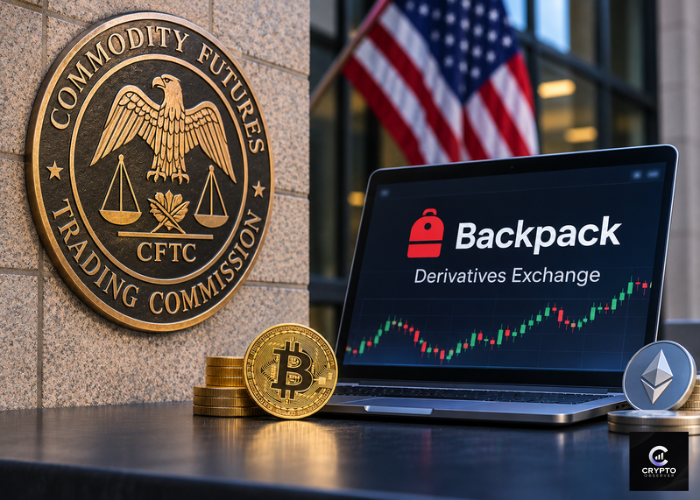
On November 16, the US Commodity Futures Trading Commission (CFTC) approved Backpack’s applications to establish a regulated cryptocurrency derivatives exchange and clearinghouse.
The approvals cover two affiliated entities: TLD Markets, operating as Backpack Exchange, and TLD Clearing, operating as Backpack Clearing.
The development establishes a regulatory foundation for Backpack to introduce leveraged cryptocurrency derivatives trading to US customers.
Two Regulatory Approvals, One Trading Infrastructure
| Entity | Regulatory Approval | Function |
|---|---|---|
| TLD Markets | Designated Contract Market (DCM) | Operate a regulated derivatives exchange |
| TLD Clearing | Derivatives Clearing Organization (DCO) | Clear and manage derivatives transactions |
The clearinghouse registration was approved on November 13, followed by the exchange designation on November 16.
This distinction matters because derivatives exchanges facilitate trading, while clearing organizations manage the financial obligations and risks associated with those transactions.
What Backpack Plans to Offer US Traders
Its planned offering includes:
- Perpetual Futures: Leveraged cryptocurrency derivatives without conventional expiration dates.
- 24/7 Trading: Continuous access to cryptocurrency derivatives markets.
- Crypto Collateral: The ability to use supported digital assets as trading collateral.
- Cross-Margining: Using eligible collateral across multiple positions to manage margin requirements.
- Unified Global Liquidity: Connecting US traders with Backpack’s broader global order book.
These features are part of the company’s announced plans. Regulatory approval does not mean every product is already available to US customers.
Why the CFTC Approval Matters
For years, offshore cryptocurrency exchanges have dominated the perpetual futures market.
Platforms operating outside the US have attracted traders through continuous trading, leverage and extensive derivatives offerings. However, American customers face regulatory restrictions on accessing many of these products.
Backpack’s approvals create a pathway for a different model: offering sophisticated cryptocurrency derivatives through entities operating under US federal regulatory oversight.
The development also demonstrates that blockchain-based market infrastructure can operate within existing financial regulatory frameworks.
This development is part of a broader shift toward building the infrastructure required for institutional crypto adoption, including custody, compliance and settlement systems.
CFTC Chairman Michael Selig has highlighted blockchain-based execution and settlement as an important development in the evolution of American financial markets.
Backpack Is Not the Only Company Moving Into Regulated Blockchain Markets
Another important development is the CFTC’s approval of tZERO’s derivatives exchange infrastructure.
Both Backpack and tZERO are working toward bringing blockchain-based financial market infrastructure into regulated US markets.
This signals growing interest in using distributed ledger technology for more than cryptocurrency transfers and custody.
The technology is increasingly being explored for trading, clearing, settlement and financial market operations.
What Happens Next?
Several factors will matter:
- Whether Backpack can attract sufficient liquidity from US market participants.
- How its perpetual futures products compete with established derivatives platforms.
- Which cryptocurrencies and collateral assets become available.
- How effectively it integrates regulatory compliance with blockchain-based trading infrastructure.
The company has announced plans for its US expansion and is accepting interest from prospective users.
The bigger development is not simply another cryptocurrency exchange entering the US market. It is the growing acceptance of blockchain-based infrastructure within regulated derivatives markets.
If Backpack successfully executes its plans, it could become an important competitor in the evolving US cryptocurrency derivatives industry.