







































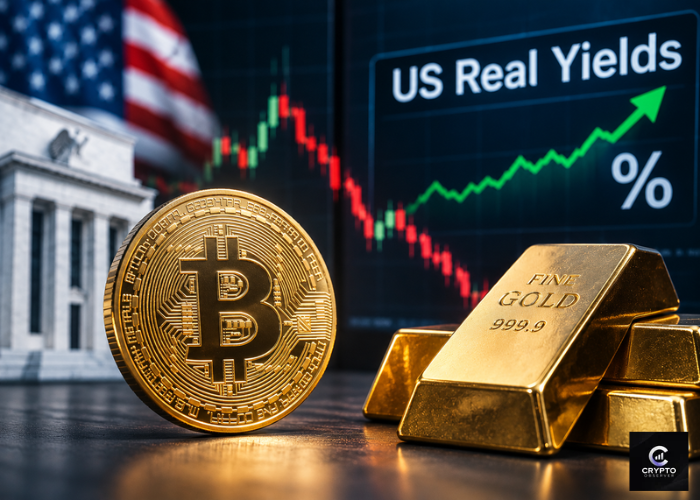
Gold and Bitcoin are facing renewed selling pressure as elevated US real interest rates and expectations of tighter monetary policy reduce the appeal of assets that generate no income. The simultaneous decline in both markets is highlighting how sensitive cryptocurrencies and precious metals remain to changes in monetary conditions, investor positioning and the strength of the US dollar.
Gold fell nearly 3% on Friday, November 20, to approximately $3,514 per ounce, reaching its lowest level since September 2025. Bitcoin was trading around $61,900, extending its quarterly decline to approximately 28%. The sell-off has placed both assets under pressure as investors reassess the attractiveness of holding non-yielding investments amid higher real borrowing costs.
Rising Real Yields Are Changing the Investment Equation
Real yields represent the return investors receive from bonds after accounting for inflation. When real yields rise, government bonds become more attractive because investors can earn inflation-adjusted returns without taking the same price volatility associated with assets such as gold and Bitcoin.
Recent US market data showed two-year real rates moving above 2.4%, while longer-term real yields climbed to levels not seen in more than two decades. The increase has strengthened the argument for income-generating investments over assets that depend primarily on price appreciation.
Unlike government bonds, gold does not pay interest, while Bitcoin does not generate cash flow or dividends. When investors can obtain higher inflation-adjusted returns from fixed-income instruments, holding these assets becomes more expensive in terms of opportunity cost.
The shift in market conditions has contributed to selling pressure across precious metals and digital assets, particularly as traders adjust portfolios to reflect expectations of tighter monetary policy.
A Stronger Dollar Adds Another Headwind
The US dollar has also strengthened amid changing interest-rate expectations, creating an additional challenge for gold and Bitcoin.
Because both assets are priced globally in dollars, a stronger greenback can make them more expensive for international buyers using other currencies. This can weaken demand and contribute to downward pressure on prices.
The dollar’s strength has also reflected investors’ preference for liquidity amid volatility across global markets. As financial conditions tighten and uncertainty increases, capital can move toward cash and dollar-denominated assets, reducing demand for alternative stores of value.
The combination of elevated real yields and dollar strength has created a difficult environment for assets that rely on investor demand rather than recurring income.
Bitcoin’s Digital Gold Narrative Faces Another Test
Bitcoin is often described as digital gold because of its limited supply and potential role as a long-term store of value. However, its latest price movement is highlighting a major distinction between the two assets: Bitcoin continues to behave like a risk-sensitive investment during periods of market stress.
Despite their different characteristics, gold and Bitcoin have both been affected by rising real yields. This challenges the expectation that Bitcoin will consistently act as a hedge when traditional financial markets experience uncertainty.
The latest market weakness also demonstrates that Bitcoin’s price remains heavily influenced by liquidity, institutional positioning and macroeconomic expectations. When investors become more cautious and prioritize yield-generating assets, Bitcoin can face selling pressure alongside other risk-sensitive investments.
For investors, the current environment raises questions about how Bitcoin may behave during prolonged periods of restrictive monetary policy and whether its long-term store-of-value narrative can withstand sustained pressure from higher real returns elsewhere.
Federal Reserve Rate Expectations Remain in Focus
Markets are increasingly focused on the Federal Reserve’s interest-rate outlook as inflation concerns continue to influence expectations for monetary policy. Persistent inflation could encourage policymakers to maintain restrictive conditions for longer or consider additional tightening.
Higher interest rates generally increase borrowing costs, reduce liquidity and potentially limit the amount of capital available for speculative investments. These conditions can weigh on cryptocurrencies, equities and other assets that rely on strong investor demand.
Bitcoin has also faced pressure from the combination of inflation concerns, weakening institutional demand and restrictive monetary expectations, as explored in our analysis of the latest Bitcoin sell-off.
The direction of inflation, future Fed decisions and movements in Treasury yields will therefore remain critical factors for Bitcoin and gold. Any indication that inflation is cooling and interest-rate expectations are easing could improve sentiment, while further hawkish signals may extend the pressure on both markets.
What Investors Are Watching Next
Bitcoin and gold are now facing a macroeconomic environment in which the opportunity cost of holding non-yielding assets has increased. Traders are monitoring US inflation data, Federal Reserve policy signals, Treasury yields and dollar movements for clues about whether the current sell-off could continue.
A decline in real yields could potentially ease pressure on both markets by making non-yielding assets more attractive relative to bonds. Conversely, persistent inflation and expectations of tighter monetary policy could continue to weigh on prices.
For Bitcoin, the latest downturn is another reminder that its market performance remains closely connected to global liquidity and macroeconomic conditions. For gold, the sell-off challenges its traditional role as a safe haven during periods of uncertainty.
Whether the two assets recover will depend partly on how monetary-policy expectations evolve. Until real yields begin moving in a more supportive direction, both Bitcoin and gold may remain vulnerable to further volatility.