





































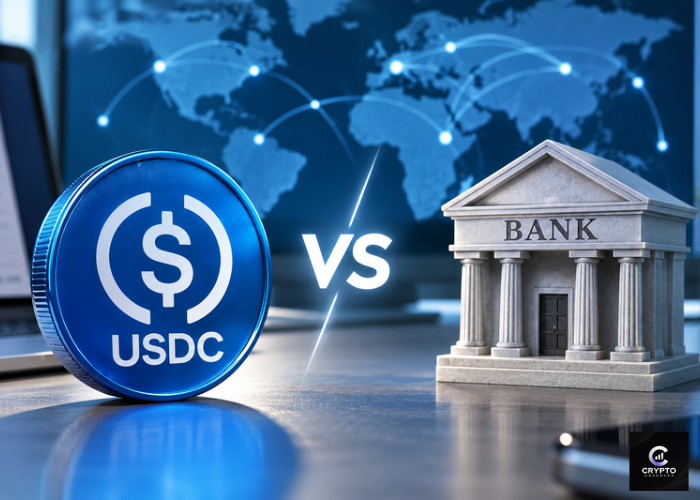
Sending money internationally remains a complicated process for many businesses. A company in the United States paying a supplier in Singapore or the United Arab Emirates often deals with multiple banks, currency conversions, intermediary fees, and settlement delays.
Stablecoins are introducing a different approach.
USDC, a dollar-backed digital currency issued by Circle, offers businesses another way to transfer dollar-denominated value across blockchain networks. Instead of relying entirely on traditional banking channels, companies can use blockchain infrastructure to transfer digital dollars between supported wallets.
This development raises an important question: Can USDC become a practical alternative to traditional international business payments?
The answer depends on more than transaction speed. Cost, liquidity, regulation, banking access, and the ability to convert digital dollars into conventional money all matter.
Why International Business Payments Remain Complicated
Traditional international payments often involve several financial institutions.
When a US company sends money to an overseas supplier, its payment might pass through the originating bank, correspondent banks, and the recipient’s banking institution before reaching the final account.
The SWIFT network plays an important role in international banking communication. However, SWIFT itself does not transfer or settle money. Financial institutions use it to exchange standardized payment instructions.
The actual movement of funds depends on the banking relationships and settlement arrangements involved.
This creates several challenges for businesses:
- Settlement delays: International payments take time to process, particularly when multiple financial institutions are involved.
- Intermediary fees: Correspondent banking arrangements can introduce additional charges.
- Currency conversion: Businesses dealing in multiple currencies face exchange-rate costs and conversion spreads.
- Limited operating hours: Traditional banking systems operate within specific business and settlement schedules.
- Payment visibility: Tracking the status of international transfers can become difficult when several institutions participate.
These limitations are particularly relevant for businesses making frequent international payments, managing overseas suppliers, or operating across multiple markets.
How USDC Changes the Payment Process
USDC approaches international payments differently.
It is a stablecoin designed to maintain a value of one US dollar per token. Circle issues USDC and maintains reserve assets intended to support its redemption at par.
Unlike a conventional bank deposit, USDC exists as a digital token on supported blockchain networks.
A business holding USDC can transfer it to another compatible wallet without requiring the transaction to follow the same correspondent banking path as a conventional international wire transfer.
Consider a simple example.
A US-based technology company needs to pay a software development agency in another country.
Under a traditional arrangement, the company initiates an international bank transfer. The payment passes through the relevant banking infrastructure before reaching the agency’s account.
With USDC, the company can transfer digital dollars to the agency’s supported wallet. The recipient can then hold the USDC, use it for another transaction, or convert it into local currency through an appropriate service provider.
The blockchain records the transfer and provides a transaction history.
This approach changes the payment infrastructure, although it does not eliminate every intermediary. Businesses still need reliable wallet services, liquidity providers, compliance procedures, and off-ramps to convert digital assets into traditional currency.
Why Businesses Are Paying Attention to USDC
Faster Settlement
Blockchain-based transfers can settle within minutes or less, depending on the network and transaction conditions.
This differs from traditional international payments, which depend on banking schedules and correspondent relationships.
For businesses, faster settlement can improve cash flow management and reduce the time spent waiting for payments to reach suppliers.
However, blockchain settlement does not guarantee immediate access to local currency. Conversion and withdrawal processes introduce additional time.
Dollar-Denominated Payments
Many international businesses already use the US dollar for invoicing, supplier payments, and financial reporting.
USDC provides a digital representation of dollar value that businesses can transfer across supported blockchain networks. Similar developments in traditional banking include Emirates NBD’s integration of the USDU stablecoin into its Liv digital banking platform, demonstrating how digital dollar infrastructure is entering established financial services.
This is particularly relevant for companies operating in countries where access to international dollar payment services is limited or expensive.
However, USDC is not equivalent to holding an insured US bank deposit. Its legal and financial characteristics are different.
Continuous Payment Availability
Traditional banking infrastructure operates according to institutional schedules, holidays, and processing windows.
Public blockchain networks operate continuously.
This means businesses can initiate USDC transfers outside conventional banking hours.
For companies operating across multiple time zones, continuous availability offers greater flexibility when coordinating international payments.
Greater Payment Transparency
Blockchain transactions are recorded on public ledgers.
Depending on the network and wallet configuration, businesses can verify transaction status, destination addresses, and transfer amounts.
This creates an additional layer of payment visibility.
However, public transaction records do not automatically establish the identity of the parties involved. Businesses still need appropriate accounting, compliance, and transaction monitoring systems.
What About Transaction Costs?
Traditional bank payments can involve:
- International wire transfer charges.
- Correspondent banking fees.
- Foreign exchange spreads.
- Receiving bank charges.
USDC transfers introduce a different cost structure.
Businesses may pay blockchain network fees, wallet service charges, liquidity provider fees, and conversion costs when moving between USDC and local currencies.
The actual cost depends on the blockchain network, payment size, service provider, and destination market.
For example, transferring USDC on a lower-cost blockchain network can be inexpensive compared with certain international wire arrangements.
However, a business that needs to convert USDC into local currency still depends on the availability and pricing of local exchanges or payment providers.
The most meaningful comparison is therefore the total cost of completing a payment, not simply the blockchain transaction fee.
The Risks Businesses Cannot Ignore
Stablecoin issuer risk
Blockchain network risk
Wallet security
Regulatory requirements
Stablecoin payments do not eliminate anti-money laundering, sanctions screening, tax reporting, or other applicable legal obligations.
Companies operating across multiple jurisdictions must evaluate the rules governing digital asset transfers and payment services in each relevant market.
Liquidity and conversion risk
Will USDC Replace Traditional International Bank Transfers?
USDC is not positioned to replace every function performed by traditional banking infrastructure.
Banks provide services beyond payment transfers, including credit facilities, deposit accounts, trade finance, foreign exchange services, and regulated financial infrastructure.
Stablecoins address a narrower but important part of this system: the movement of digital dollar value.
For certain businesses, USDC offers a practical alternative for international settlements, particularly when both parties already have access to digital asset infrastructure.
For others, traditional bank transfers remain more convenient because of established accounting systems, regulatory requirements, supplier preferences, and direct access to local currency.
The two systems can also operate together.
A company might use traditional banking for payroll, lending, and domestic operations while using USDC for selected international payments.
This approach does not require businesses to abandon their existing financial relationships.
The Bigger Opportunity Is Beyond Crypto Trading
The growing relevance of USDC is not limited to cryptocurrency exchanges or digital asset investors.
Its potential business applications include supplier payments, international contractor settlements, corporate treasury transfers, and cross-border financial operations.
These use cases represent a shift in how businesses think about payment infrastructure.
For years, stablecoins were primarily associated with cryptocurrency trading and decentralized finance. Their use as digital payment instruments introduces a different conversation, one focused on operational efficiency and financial infrastructure.
The important question for businesses is no longer simply whether stablecoins can transfer money.
It is whether they can provide a more efficient, reliable, and compliant way to move money across borders.
USDC has established itself as one of the prominent dollar-backed stablecoins in this discussion. Its long-term role in business payments depends on continued confidence in its reserves, redemption mechanisms, regulatory treatment, and supporting infrastructure.
Traditional banking is not disappearing. However, businesses now have another payment model to evaluate.